

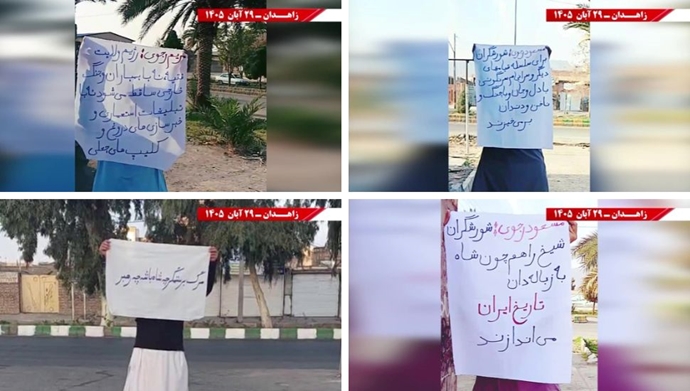

On November 20, 2026, PMOI Resistance Units affiliated resumed their weekly anti-regime activities in Zahedan, southeastern Iran, displaying placards in public places to reaffirm their commitment to overthrowing the clerical regime and rejecting all forms of dictatorship, whether religious or monarchical.
The activities highlighted several pressing issues facing Iran, including the regime’s escalating campaign of executions, the plight of political prisoners, growing economic hardships, and the prospect of renewed popular uprisings. The Resistance Units also celebrated the international recognition of political prisoner Mohammad Javad Vafaei Sani and reiterated their rejection of both the ruling theocracy and attempts to restore the former monarchy.
“The overthrow of the regime and the establishment of a free Iran is the responsibility of our people and Resistance,” read one placard.
November 20—Zahedan, southeast Iran
PMOI/MEK Resistance Units resume weekly activities, reiterating their commitment to the struggle to overthrow the mullahs' regime and their rejection of all forms of dictatorship, whether religious or monarchical. pic.twitter.com/1XvXqFQFRU— People's Mojahedin Organization of Iran (PMOI/MEK) (@Mojahedineng) November 21, 2026
The activities followed the November 13 campaign in Zahedan commemorating the seventh anniversary of the November 2019 uprising, during which Resistance Units emphasized their determination to continue the struggle for freedom and democracy.
Solidarity with political prisoners amid escalating executions
A central message of the November 20 activities was solidarity with political prisoners and condemnation of the regime’s increasing reliance on executions.
“The ‘Outstanding Human Rights Activist’ award presented to Mohammad Javad Vafaei Sani represents support for all political prisoners in Iran,” read one placard.
Vafaei Sani, an Iranian boxing champion and PMOI supporter who faces execution, received the 2026 Magnitsky Award for Outstanding Human Rights Activist in absentia at a ceremony in London on November 12. His recognition has drawn attention to the plight of political prisoners facing death sentences in Iran.
"Pezeshkian imagines that by gradually injecting backbreaking price hikes, the regime can survive the people's uprising." pic.twitter.com/hzhzMQLElS
— People's Mojahedin Organization of Iran (PMOI/MEK) (@Mojahedineng) November 21, 2026
The activities also came amid another wave of executions. On November 19, the National Council of Resistance of Iran (NCRI) reported that at least 13 prisoners had been executed on November 17 and 18. The executions coincided with the adoption of a resolution by the UN General Assembly’s Third Committee condemning systematic human rights violations in Iran.
Another placard condemned the regime’s supreme leader for resorting to executions, particularly against PMOI members and rebellious youth, to confront the growing challenge to his rule.
Rejecting both the shah and the mullahs
Another prominent theme of the activities was the rejection of both the ruling clerical and a return to the former dictatorial monarchy. The Resistance Units displayed several placards emphasizing that Iran’s future must be founded on freedom and democracy rather than a return to past forms of dictatorship.
“Down with the oppressor, be it the shah or the supreme leader,” declared one placard. Another stated, “A dictator is a dictator, whether with a crown or a turban.”
Other messages dismissed the political maneuvers of the son of Iran’s deposed shah and rejected the prospect of restoring monarchical rule.
"The fascist slogans 'Long live the Shah,' 'The only party is Rastakhiz,' 'The only party is Hezbollah,' and 'Khamenei is the Leader' must be discarded" pic.twitter.com/Ep66uCDyg7
— People's Mojahedin Organization of Iran (PMOI/MEK) (@Mojahedineng) November 21, 2026
One placard drew a parallel between authoritarian slogans associated with the monarchy and the current regime, condemning both as expressions of the same dictatorial mindset.
The Resistance Units summarized their political position in a message that has become a recurring theme of their weekly activities: “No to shah, no to mullahs. Yes to freedom and a democratic republic.”
These messages echoed their November 13 activities, when Resistance Units in Zahedan marked the anniversary of the 2019 uprising by rejecting both clerical and monarchical dictatorship.
Preparing for future uprisings despite repression
The Resistance Units also emphasized the potential for renewed nationwide uprisings, pointing to growing public discontent and the regime’s reliance on repression to maintain its grip on power.
“More than ever, the conditions are ripe to rise for another great uprising,” read one placard.
Another declared, “The uprising force of society is more powerful than the regime’s repression.”
"The democratic revolution of the people of Iran will be victorious with the backing of the blood of its martyrs" pic.twitter.com/wgSN84Pq8l
— People's Mojahedin Organization of Iran (PMOI/MEK) (@Mojahedineng) November 21, 2026
The messages also addressed the country’s economic crisis, criticizing President Masoud Pezeshkian’s approach to raising prices. One placard warned that Pezeshkian was mistaken in believing the regime could survive popular anger by gradually imposing backbreaking price hikes.
The Resistance Units also condemned plans to install CCTV cameras in classrooms, portraying the measure as evidence of the regime’s fear of students’ participation in future uprisings.
Rejecting reliance on foreign military intervention or propaganda campaigns, the Resistance Units stressed the necessity of organized domestic resistance and popular mobilization.
“Our solution is the overthrow of the mullahs’ regime by the people of Iran, through organized uprisings and the vanguard role of the Resistance Units and the National Liberation Army,” read another placard.
Continuing the struggle for a democratic republic
The November 20 activities in Zahedan reflected the Resistance Units’ determination to continue their campaign against the clerical regime while rejecting any return to monarchical dictatorship.
Their messages connected the growing execution campaign, economic hardship, and political repression with calls for organized resistance and future uprisings. They also reiterated the responsibility of the Iranian people and their Resistance to determine the country’s political future.
“The people of Iran are determined to overthrow the mullahs’ regime and establish freedom and democracy,” read one placard.
By continuing their weekly activities, the Resistance Units reaffirmed their commitment to a struggle aimed not merely at replacing the current rulers but at ending dictatorship and establishing a free and democratic republic.