

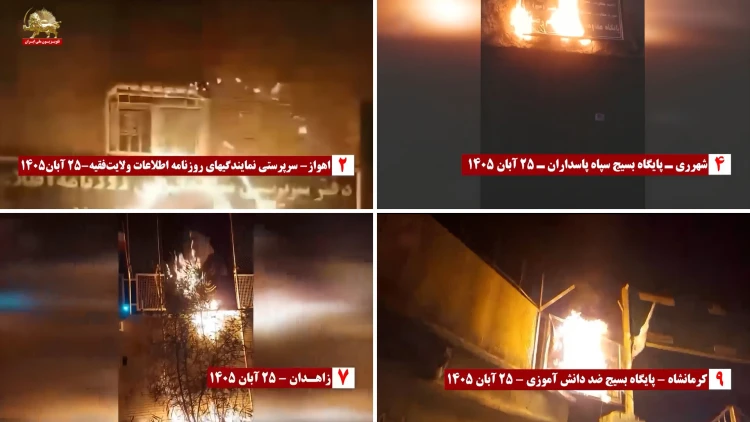

On November 16, 2026, Resistance Units affiliated with the People’s Mojahedin Organization of Iran (PMOI/MEK) carried out 20 operations against the Iranian regime’s centers and symbols of repression, marking the seventh anniversary of the November 2019 uprising.
The operations took place in Tehran and several other cities, targeting bases of the Islamic Revolutionary Guard Corps (IRGC) Basij, regime-affiliated institutions, and propaganda symbols featuring current and former regime leaders. The activities commemorated the more than 1,500 protesters killed during the November 2019 uprising and demonstrated the Resistance Units’ determination to continue the struggle for freedom and democracy.
November 16—Iran
PMOI/MEK Resistance Units carry out 20 daring operations against regime targets to mark the seventh anniversary of the November 2019 uprising. Their bravery is testament to the fact that the spirit of the uprising lives on and the people of Iran will not stop… pic.twitter.com/ZD9JitKdAp— People's Mojahedin Organization of Iran (PMOI/MEK) (@Mojahedineng) November 18, 2026
The operations were part of a broader anniversary campaign aimed at keeping the spirit of the November 2019 uprising alive and preparing the ground for future nationwide uprisings against the regime.
Targeting the regime’s centers of repression
A significant portion of the November 16 operations targeted institutions associated with the regime’s security and repressive apparatus, particularly the IRGC Basij.
In Kermanshah, western Iran, Resistance Units targeted a regime center associated with spreading fundamentalism and terrorism. In two separate operations, they set fire to the entrance and signpost of IRGC Basij bases.
In Ahvaz, southwest Iran, Resistance Units set fire to a regime building, while in Rey, near Tehran, they targeted the signpost of an IRGC Basij base.
Kermanshah
Resistance Units set fire to entrance of IRGC Basij base pic.twitter.com/EZwXjIl8C4— People's Mojahedin Organization of Iran (PMOI/MEK) (@Mojahedineng) November 18, 2026
In southeastern Iran, Resistance Units set fire to the entrance of an IRGC Basij base in Zahedan and targeted another Basij base in Rask.
Further operations took place in Mahshahr, where Resistance Units targeted an IRGC Basij base. Mahshahr holds particular significance in the history of the November 2019 uprising. The city witnessed one of the deadliest episodes of the regime’s crackdown, when security forces opened fire on protesters, killing scores of people.
The targeting of Basij facilities carries particular significance because the IRGC and Basij were instrumental in suppressing the November 2019 protests. Seven years later, these institutions remain among the principal targets of the Resistance Units’ operations.
Challenging the regime’s propaganda and symbols of authority
Alongside operations against security institutions, Resistance Units carried out attacks against propaganda banners, posters, and billboards displaying images of the regime’s leadership.
In Zahedan and Nikshahr, southeastern Iran, Resistance Units torched large propaganda banners featuring former supreme leader Ali Khamenei. Similar operations took place in Jolfa and Marivan, where regime propaganda banners were set on fire.
Zahedan
Resistance Units set fire to entrance of IRGC Basij base pic.twitter.com/Lw0UZxwbM1— People's Mojahedin Organization of Iran (PMOI/MEK) (@Mojahedineng) November 18, 2026
In Kermanshah, Resistance Units torched a propaganda poster featuring both Ali Khamenei and his successor, Mojtaba Khamenei. In Isfahan, two separate operations targeted a regime propaganda billboard and banner.
The campaign also reached the capital. In Tehran, Resistance Units torched three propaganda banners featuring Ali Khamenei, including one displaying his image alongside Mojtaba Khamenei.
By targeting these public symbols, the Resistance Units challenged the authority of the ruling establishment and demonstrate their rejection of the clerical dictatorship.
The November 2019 uprising: A legacy of resistance
The November 2019 uprising began on November 15, following a sudden increase in gasoline prices. What started as protests against economic hardship rapidly developed into a nationwide movement calling for an end to the clerical regime.
The protests spread to more than 190 cities, with demonstrators challenging the ruling establishment despite the deployment of security forces.
Zahedan
Resistance Units large propaganda banner featuring former regime supreme leader Ali Khamenei pic.twitter.com/3tHc7MQWah— People's Mojahedin Organization of Iran (PMOI/MEK) (@Mojahedineng) November 18, 2026
The regime responded with lethal force, killing at least 1,500 protesters and arresting more than 12,000 people. Authorities also imposed a near-total internet blackout to restrict the flow of information about the crackdown.
Despite the repression, the uprising became a defining moment in Iran’s struggle for political change, exposing the depth of public opposition to the regime and the willingness of protesters to confront its security apparatus.
Keeping the uprising alive and preparing for the next revolt
The November 16 operations followed a series of coordinated activities by PMOI Resistance Units throughout November 2026.
On November 2, Resistance Units carried out 30 operations against regime institutions and symbols of repression as part of a broader campaign of 90 activities across Tehran and 24 other cities.
On November 13, Resistance Units in Zahedan commemorated the uprising by displaying placards expressing their determination to overthrow the regime and rejecting both clerical and monarchical dictatorships.
A day later, on November 14, Resistance Units carried out another 30 operations across Tehran and 16 other cities, targeting Basij bases, regime-affiliated institutions, and propaganda symbols.
Together, these activities reflect a sustained effort to keep the legacy of November 2019 alive and challenge the atmosphere of fear imposed by the regime’s repression.
For the Resistance Units, commemorating November 2019 is not simply about remembering those killed in the uprising. It is also about continuing their struggle and building momentum for future protests.
Seven years after the uprising, the Resistance Units are preserving its spirit of defiance, expand organized resistance, and prepare the ground for the next nationwide uprising aimed at establishing a democratic republic that rejects all forms of dictatorship.