

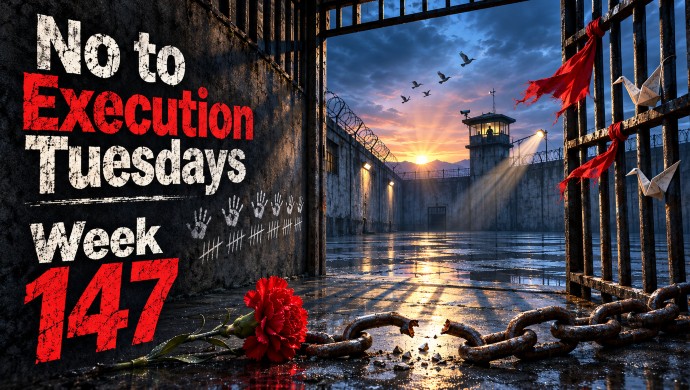

Prisoners across 67 facilities in Iran staged a coordinated hunger strike on Tuesday, November 17, 2026, marking the 147th consecutive week of the “No to Executions Tuesdays” campaign. According to a statement issued by the striking inmates, prisoners at Noorabad Mamasani Prison in Fars Province joined the protest this week, expanding the weekly demonstration against the issuance and execution of death sentences and the deprivation of the fundamental right to life.
The prisoners noted that the campaign has continued uninterrupted for nearly three years even as participants have faced security pressures, threats, restrictions on contact and communication with the outside world, and punitive measures over recent weeks—actions aimed at exhausting the prisoners’ will and silencing their protest.
Surge in executions and death sentences against protesters
In their statement, the striking prisoners reported that between March 21 and November 17, 2026, Iranian authorities executed more than 607 prisoners, including 21 women, calling the figure “an appalling statistic that demonstrates the vast dimensions of the machinery of execution and repression.”
The campaign also highlighted immediate threats to political prisoners and detainees from the January 2026 nationwide uprising. During the past week, the death sentence of Peyman Farahavar was formally served to him at the Sentence Implementation Office of Lakan Prison in Rasht, leaving him at high risk of imminent execution. In addition, the judiciary issued death sentences for two political prisoners arrested during the January 2026 uprising: Mohammad Mehdi Parsa in Ahvaz and Omid Janami in Zarrinshahr, Isfahan Province. The statement described these rulings as “an act continuing the repression and killing of protesters with the aim of creating terror and fear in society.”
The prisoners specifically cited Judge Abolghassem Salavati—notoriously known as the “Judge of Executions”—for issuing death sentences against numerous citizens over the years, particularly protesters detained during the November 2019 uprising. While noting that executions for several of those protesters were eventually halted through collective public outcry, the statement pointed out that Salavati remained in his judicial post.
“The ‘No to Executions Tuesdays’ campaign warns such human-rights-hostile judges that the day of reckoning for their actions is not far off, and on that day, they will have no excuse to shirk their responsibility,” the prisoners declared.
Custodial death of Kurdish programmer Peyman Salehi
Beyond judicial executions, the Week 147 statement detailed an apparent custodial killing in Tehran. According to the prisoners, Peyman Salehi, a Kurdish citizen from Bukan and a computer programmer residing in Tehran, was arrested on November 9, 2026, by the Tehran Intelligence Department. Two days later, on November 11, 2026, his lifeless body was returned to his family bearing marks of beating and torture.
“In another crime, Peyman Salehi, a Kurdish citizen from Bukan and a programmer living in Tehran, was arrested on November 9, 2026 by the Tehran Intelligence Department, and two days later, his lifeless body with signs of beating and torture was handed over to his family,” the statement read. “This level of state violence once again recalls the necessity of accountability and ending repression, violence, and arbitrary killings against citizens.”
Commemorating the seventh anniversary of the November 2019 uprising
The Week 147 statement also marked the seventh anniversary of the nationwide protests of November 2019, recalling the killing of 1,500 protesters and the imprisonment of 10,000 citizens during the state crackdown.
“On the seventh anniversary of the November 2019 protests, during which the blood of thousands of unarmed protesters was spilled by the ruling despots and ten thousand protesting citizens were imprisoned, we honor the memory of the fallen and the injured and pay tribute to the pure souls of its 1,500 proud martyrs—those who courageously stepped onto the field of struggle for equality, freedom, and a dignified life, and whom the ruling establishment shot, marking a bloody [month],” the prisoners wrote.
“We pledge to them to continue their path until their ideals are realized, and as in past years when we chanted in prisons, we cry out: [That uprising] continues; in every alley and street and across all of Iran. [It] continues, even if bullets rain upon us day and night.”
Expanding solidarity inside Iran and international support
Alongside the expansion of the strike to Noorabad Mamasani Prison, the campaign noted growing solidarity outside prison walls. Several teachers’ and retirees’ trade associations issued statements backing the “No to Executions Tuesdays” campaign, while retirees staged street demonstrations in Rasht, Shush, Tehran, and other cities, chanting “No to Executions.”
“Despite repression and executions, we are witnessing magnificent resistance and solidarity against executions,” the prisoners wrote. “We invite all segments of the population, trade unions, workers, and political and civil activists to join this campaign. We hope every Iranian becomes a member of this collective movement against executions.”
The prisoners’ nearly three-year protest has also drawn increasing international backing in recent weeks. Prominent United Nations and legal figures—including Andrea Bolaños Vargas, UN Special Rapporteur on the Situation of Human Rights Defenders; Leopoldo Maldonado Gutiérrez, UN Special Rapporteur on the promotion and protection of the right to freedom of opinion and expression; Gina Romero, UN Special Rapporteur on the rights to freedom of peaceful assembly and of association; Ana Lorena Delgadillo of the UN Working Group on Enforced or Involuntary Disappearances; former UN Special Rapporteur David R. Boyd; and Alexis Anagnostakis, Chair of the Human Rights Committee of the European Criminal Bar Association—have publicly expressed solidarity with the campaign, with several participating in 24-hour solidarity hunger strikes.
Taken together, the continuation of the weekly hunger strike across 67 prisons despite punitive retaliation, coupled with parallel statements from domestic trade unions, street chants by retirees, and growing international solidarity, reflects an organized resistance challenging the Iranian regime’s reliance on capital punishment both inside detention centers and across broader society.