

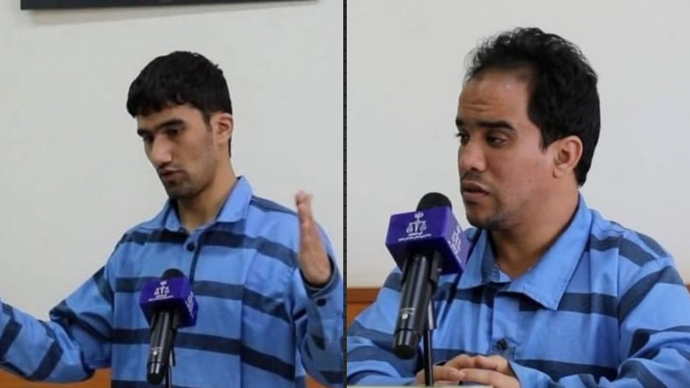

Iranian authorities executed Ali Hemmati, 21, and Majid Nik-Andish, 25, at dawn on September 30, months after the two young men were arrested in connection with the January 2026 uprising in Mashhad.
The regime’s judiciary described Hemmati and Nik-Andish as “leaders” and “field elements” of the protests in Mashhad’s Tabarsi district and alleged that their actions during the unrest led to the deaths of four members of the security forces. Their death sentences were upheld by the Supreme Court before being carried out.
Iran's regime has executed two protesters from the January uprising, Ali Hemmati and Majid Nik-Andish, in Mashhad.
Mizan, the Iranian regime judiciary’s news agency, announced that the reason for the execution of the two rebels was their participation “in the December… pic.twitter.com/hHMbygpCxL
— People's Mojahedin Organization of Iran (PMOI/MEK) (@Mojahedineng) September 30, 2026
The executions add Hemmati and Nik-Andish to the growing number of protesters put to death following the nationwide uprising that began in January.
The judiciary’s case against the two protesters
The regime’s judiciary claimed that Hemmati and Nik-Andish took part in protests in the Tabarsi district on January 8 and 9. Authorities accused them of involvement in acts including arson, destruction of property, blocking roads and attacks on security forces.
State media also relied on what they described as confessions by the two men. The judiciary claimed Hemmati admitted during interrogation and judicial proceedings to setting fire to a store, obstructing traffic and injuring a member of the security forces. It alleged Nik-Andish admitted to participating in the January 8–9 protests, carrying a knife, damaging public property and joining an attack on a store.
These allegations are based on confessions obtained under torture and pressure.
The regime’s judiciary claimed that the defendants and their lawyers were present at trial and that the death sentences were subsequently reviewed and upheld by the Supreme Court. But the judiciary’s September 30 announcement did not identify the court that tried the case or state where the executions were carried out.
Iran Human Rights Society noted that independently available information about the proceedings and the allegations against the two men remains limited, underscoring questions about the evidence, interrogation process and ability to mount an effective defense.
Executions become part of the response to the January uprising
The executions are not isolated. On May 4, the judiciary announced the executions of Mehdi Rasouli, Mohammadreza Miri and Ebrahim Dowlat-Abadi, three other protesters accused of “leading and directing” protesters in the Tabarsi district of Mashhad.
The broader figures show how extensively the death penalty has been used in cases connected to the January uprising. On September 14, Iran Human Rights reported that at least 100 people arrested in connection with the protests had been sentenced to death, including five who were under 18 at the time of their alleged offenses and five women. The organization said 29 people arrested over the January protests had already been executed since March 18.
Also documented are systemic fair-trial concerns in protest cases, including restrictions on defendants’ ability to choose lawyers and the use of torture and coerced confessions.
Iranian Resistance warns executions are intended to intimidate protesters
The Iranian Resistance has warned that the accelerating executions are intended to raise the cost of dissent and deter another round of nationwide protests.
Mrs. Maryam Rajavi, President-elect of the National Council of Resistance of Iran, called on the international community to act to halt executions, particularly those of political prisoners and people detained during the uprising.
Once again, the oppressive clerical regime in Iran has committed a brutal crime by executing two brave protesters, Ali Hemmati and Majid Nikandish, in Mashhad Prison. The regime’s brutal judiciary labeled them as "activists and leaders of the uprising" in Tabarsi, Mashhad.…
— Maryam Rajavi (@Maryam_Rajavi) September 30, 2026
“These executions reveal the regime’s fear and aim to intimidate the public, but they only redouble the youth’s determination,” she said.
Mrs. Rajavi also called for the dossier of arbitrary executions and systematic human rights violations in Iran to be referred to the UN Security Council and urged immediate international measures to stop further executions.
With scores of January protest defendants still facing death sentences, the executions of Hemmati and Nik-Andish place renewed attention on the authorities’ expanding use of capital punishment in the aftermath of the uprising—and on warnings that more protesters could be put to death.