

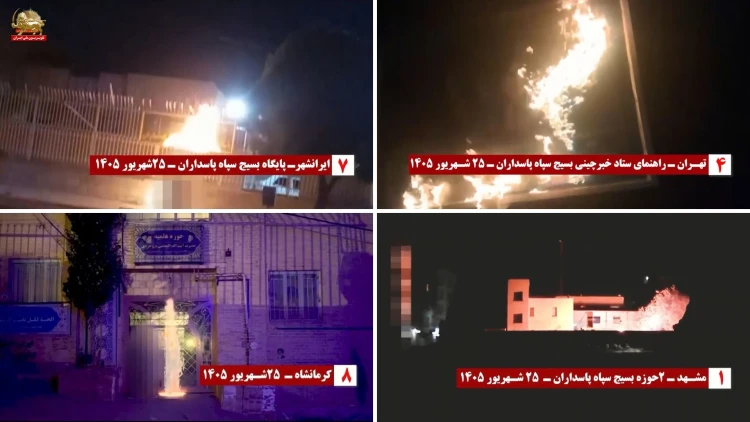

On September 14, 2026, PMOI/MEK Resistance Units marked the fourth anniversary of Iran’s 2022 nationwide uprising with 40 operations against regime targets across the country.
The operations detailed in the reports extended across at least 19 cities, from Tehran, Mashhad, and Kermanshah to Zahedan, Bandar Abbas, Ahvaz, and Bushehr. They were carried out as the regime placed its security apparatus on special alert ahead of the anniversary and intensified its threats against the PMOI and its supporters.
September 14—Iran
PMOI/MEK Resistance Units mark the 4th anniversary of Iran's 2022 nationwide uprising with 40 daring operations against regime targets across the country. pic.twitter.com/GS9iJAz7Iw— People's Mojahedin Organization of Iran (PMOI/MEK) (@Mojahedineng) September 18, 2026
The campaign demonstrated that, despite four years of repression, organized resistance continues to operate across Iran and challenge the regime at a highly sensitive moment.
Targeting the regime’s centers of repression and control
Several of the operations struck facilities associated with the IRGC Basij, one of the regime’s principal instruments of domestic repression. Resistance Units targeted a Basij base in Mashhad, set fire to the entrance and premises of a Basij base in Bam, and burned the signpost of another Basij base in Iranshahr.
In Mashhad and Kermanshah, Resistance Units targeted regime centers used to spread fundamentalism and terrorism.
Other operations challenged the regime’s surveillance apparatus. In Tehran, Resistance Units set fire to two large propaganda billboards promoting departments of the Ministry of Intelligence and the IRGC used to spy on citizens and dissidents. Similar billboards were targeted in Iranshahr and Bushehr.
Tehran
Resistance Units set fire the large regime propaganda billboard promoting the IRGC's department for spying on citizens and dissidents pic.twitter.com/E9089P7mpd— People's Mojahedin Organization of Iran (PMOI/MEK) (@Mojahedineng) September 18, 2026
By selecting institutions linked to repression, intelligence gathering, and ideological control, the operations directly challenged the apparatus the regime relies on to intimidate the population and prevent another uprising. Their geographic spread also showed that these acts were not confined to the capital or a single province.
Challenging the symbols of dictatorship
A large part of the campaign targeted the propaganda symbols through which the regime attempts to project authority and impose political conformity.
Resistance Units burned posters and banners depicting current regime supreme leader Mojtaba Khamenei and former supreme leader Ali Khamenei in Tehran, Karaj, Bandar Abbas, Neyshabur, Yazd, Sari, Qom, Zanjan, Zahedan, Birjand, Sabzevar, Saveh, Babol, and Kermanshah.
In Qom, an operation targeted a poster depicting Ali Khamenei alongside regime founder Ruhollah Khomeini. In Kermanshah and Ahvaz, Resistance Units burned images of former IRGC Quds Force commander Qasem Soleimani. Other propaganda billboards and banners were targeted in Neyshabur and Birjand.
Kermanshah
Resistance Units set fire to entrance of regime center for the spread of fundamentalism and terrorism pic.twitter.com/m2rcbiR4O1— People's Mojahedin Organization of Iran (PMOI/MEK) (@Mojahedineng) September 18, 2026
The public destruction of these symbols conveyed a clear message: the regime’s carefully constructed cult of leadership cannot conceal the rejection of the ruling system within Iranian society.
The uprising the regime could not erase
The operations took place on the anniversary of the nationwide uprising that erupted following the death of Mahsa Zhina Amini on September 16, 2022. Protests beginning in Saqqez and Tehran quickly spread across Iran and developed into calls for the overthrow of the regime.
The uprising reached more than 282 cities. At least 750 protesters were killed by the regime’s security forces, and approximately 30,000 people were arrested. Women and young people stood at the forefront of the protests.
The regime used killings, mass arrests, torture, and executions to suppress the uprising. But while it forced the mass demonstrations from the streets, it failed to eliminate their underlying demand for freedom and regime change.
The flame of resistance remains alive
Four years of repression and brutality have not restored the regime’s wall of fear. By operating across numerous cities and targeting institutions and symbols of repression, the Resistance Units transformed the anniversary from an occasion of remembrance into a renewed challenge to the ruling system.
Their operations connected the sacrifice of the uprising’s 750 martyrs with the continuing struggle for the regime’s overthrow. They also demonstrated that the flame ignited in September 2022 remains alive within Iranian society.
Through their organized defiance, the Resistance Units are preserving that flame and preparing the ground for the next nationwide uprising that will bring an end to the clerical regime.