

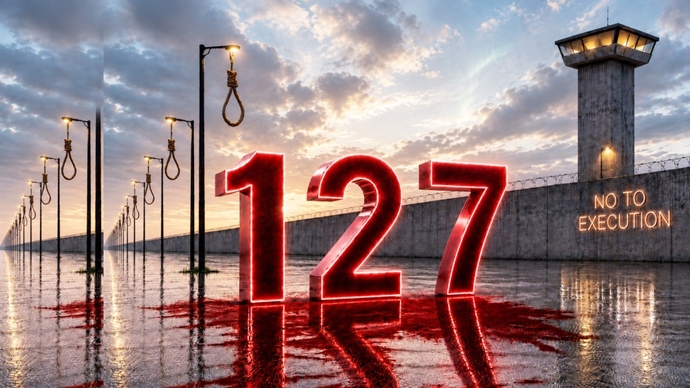

Political prisoners participating in the “No to Execution Tuesdays” campaign have entered the 127th consecutive week of coordinated hunger strikes on June 30, with inmates in 57 prisons across Iran joining the protest against the regime’s escalating use of executions and political repression.
The campaign’s latest statement warns that the Iranian regime continues to rely on executions as a central instrument of intimidation, while simultaneously expanding arrests and prosecutions in the aftermath of the nationwide protests that erupted in January 2026: “The ruling tyrannical government’s machine of execution and suppression continues its work, and we witness daily executions of political prisoners and public-crime prisoners across the country.”
Thousands Arrested Following January Protests
According to the campaign, the regime’s judiciary has acknowledged that 3,292 people have been arrested since the recent conflict on accusations of “cooperating with the enemy.” The statement argues that these figures come as authorities intensify their crackdown on dissent following the suppression of the January nationwide protests.
Campaign organizers warn that many of those detained now face severe judicial consequences: “Following the suppression of the nationwide protests of January 2026, the crackdown on protesters has entered a new phase, and a large portion of those arrested face the issuance of death sentences or long-term imprisonment.”
The statement also highlights regional reports illustrating the scale of the repression. Authorities in Sari have reportedly opened 700 legal cases against January protesters, while officials in Mashhad have acknowledged that thousands of cases have been filed against those arrested during the uprising.
Executions Continue at Alarming Pace
The campaign says the regime executed 140 people during the Iranian month of Khordad (May 22–June 21), describing the figure as further evidence that capital punishment remains one of Tehran’s primary tools for silencing dissent and intimidating society: “This government’s record is filled with extensive and blatant violations of human rights and the use of execution as a tool for suppression and intimidation.”
Human rights organizations have repeatedly warned that Iran remains one of the world’s leading executioners per capita, with political prisoners, ethnic minorities, and marginalized communities disproportionately affected by death sentences.
Families Denied the Right to Mourn
A significant portion of the statement focuses on the suffering of families whose executed relatives have disappeared into the regime’s prison system without proper notification or burial information.
The campaign recalls the case of Vahid Bani Amerian, a PMOI member and political prisoner executed in Ghezel Hesar Prison earlier this year alongside five other political prisoners. According to the statement, his family, like many others, has not been told where he was buried.
“Where is my son’s grave?” the statement asks, describing the father’s plea as “the cry of many seeking justice who have been deprived of even the basic right to know the burial location of their loved ones.”
Campaign organizers argue that withholding burial locations amounts to continuing punishment even after execution: “This deprivation is the continuation of punishment after death and a blatant violation of human dignity, where suffering neither ends nor is even allowed mourning.”
Hunger Strike Continues in 57 Prisons
Despite increasing repression, prisoners participating in the “No to Execution Tuesdays” campaign reaffirmed that they will continue their weekly hunger strikes: “Without stopping, every Tuesday, they remind us that the death penalty must be abolished, and freedom and equality must be established in Iran.”
The campaign announced that prisoners in 57 detention facilities across the country—including Evin Prison, Ghezel Hesar Prison, Greater Tehran Prison, Qarchak Prison, Adelabad Prison, Zahedan Prison, Rasht Prison, Tabriz Prison, Urmia Prison, Sanandaj Prison, Kerman Prison, and dozens of others—participated in the coordinated hunger strike marking Week 127 on June 30, 2026.
A Growing Symbol of Resistance
The “No to Execution Tuesdays” campaign has become one of the longest-running organized acts of resistance from inside Iran’s prison system. By maintaining weekly hunger strikes across an expanding network of prisons, political prisoners continue to draw attention to the regime’s widespread use of capital punishment, the targeting of dissidents after the January protests, and the broader human rights crisis confronting the Iranian people.
As arrests increase and more detainees face the possibility of execution, the campaign’s weekly protests underscore the growing determination of political prisoners to resist state repression despite the enormous personal risks they face.