

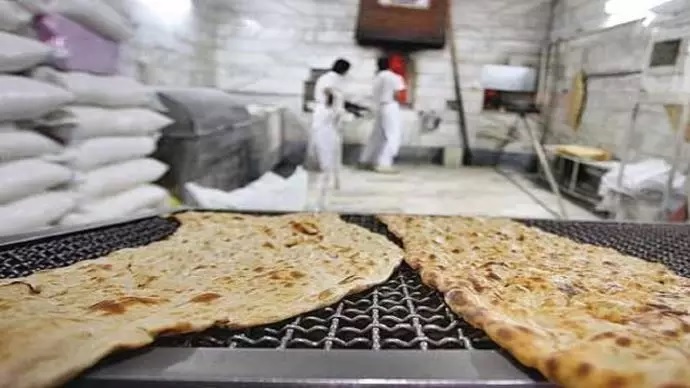

Recently, the high price of bread has become one of the main issues discussed in Iran’s state-run media. Since July 10, when bread high price became one of the country’s main crises, no government official is willing to take responsibility.
How is it possible that the most basic and fundamental part of the people’s diet become 30-40% more expensive while the government announced it is not intending to increase the price of bread? Past experience shows that the government is behind the price hike and is using it to pocket the people’s money.
On June 7, the Farda website quoted the advisor to the Minister of Economy as saying, “The government’s emphasis is not on increasing the price of bread. The emphasis of the government is to apply non-price models to support bakers.” This ambiguous statement leaves a lot of room for interpretation without giving any clear explanation as to why bread has suddenly become much more expensive.
It sounds as if every government media has its own mission to further confuse the public. One outlet wrote that bread has become expensive only in Mashhad, while others reported that instructions apply to the entire country. Yet another outlet wrote that the price of bread was to be increased since March. And another news website claimed that the government has not yet declared an official price.
Consider this example: On July 9, Tasnim News Agency, affiliated with the IRGC Quds Force, reported, “Bread has not had any price increase and any price increase and overselling of bread is prohibited and violators will be punished.”
On July 25, the IRGC-affiliated Fars News Agency, reporting from Mashhad, wrote, “Since this morning, the price of bread has suddenly increased in Khorasan Razavi province.”
On July 26, the state-run IMNA news agency wrote, “The head of the Mashhad bakers’ union confirmed and announced that a 30-40% bread price increase has been approved.”
On the same day, a reporter for IMNA quoted Mohammad Reza Khajeh, Vice President of Grain Science and Technology Association, as saying, “Deputy governors in different cities and provinces have changed the price of bread according to their preferences.”
It is certainly clear that no official or trade union authority through the official media plainly tells the people what is the story of the high price of bread, and why this sudden price difference is happening in Mashhad. Doesn’t the government have a minister for these affairs and a spokesperson to make an official announcement to the whole country?
This is yet another example of the regime resorting to spreading all kinds of contradictory and unofficial news in fear of the explosion of public anger.
The economic desperation that regime is facing now stems from the combination of its fear of a sudden explosion like the nationwide protests that followed the increase in the price of gasoline in 2019. The ongoing unrest in the society that the regime still grapples with is the basis of its desperate policy of increasing the price of bread and other policies such as the return of the morality police. There is no state-run media or regime official that does not feel the pent up anger of the public that will eventually lead to another uprising that will overthrow the regime.